

A polished pitch deck can hide a fragile investment architecture. Sophisticated capital does not underwrite real estate funds on presentation quality alone. The best metrics for real estate fund due diligence are the ones that expose how returns are produced, how risk is absorbed, and how capital is protected when execution meets friction.
For accredited investors, family offices, and institutional LPs, the issue is rarely whether a fund can show an attractive target return. The real question is whether the manager has built a repeatable machine with disciplined acquisition logic, controlled leverage, credible reserves, and governance that survives scrutiny. Metrics matter because they reveal operating truth. This complete guide breaks down the best metrics for real estate fund due diligence — the ones serious allocators use to move beyond a compelling narrative and into verifiable performance.

Best metrics for real estate fund due diligence start with cash reality
The first discipline is separating realized performance from projected performance. Many managers lead with IRR because it is elegant, familiar, and highly sensitive to quick exits. That makes it useful, but also easy to overstate if the fund relies on optimistic timing assumptions.
DPI, or distributions to paid-in capital, deserves more attention than it typically receives. DPI tells you how much actual cash has been returned relative to the capital contributed. A fund with strong DPI has converted business plans into money back in the investor’s account. That is different from paper appreciation, and for serious allocators, the distinction is not academic.
TVPI, or total value to paid-in capital, adds both distributed and unrealized value. It helps measure the full economic picture, but it must be read with skepticism if a large portion of the value remains marked rather than monetized. Unrealized marks are opinions until proven by a closing. This is why the best metrics for real estate fund due diligence always weight realized cash above projected appreciation.
RVPI, or residual value to paid-in capital, completes the trio. It captures the unrealized portion still sitting in the fund. A high RVPI is not inherently negative, but it does mean the manager still has more to prove. Funds earlier in their life naturally carry more RVPI. Mature funds that still depend heavily on unrealized marks warrant closer inspection.
IRR matters, but only in context
Internal rate of return remains one of the most cited metrics in private real estate for good reason. It accounts for time and can reward efficient capital turnover. In strategies that acquire off-market assets, execute light-to-moderate repositioning, and monetize on compressed hold periods, IRR can be a relevant indicator of operational precision.
But IRR has a known weakness. It can rise sharply when capital is returned quickly, even if the total profit multiple is modest. A manager can show an impressive IRR through short-duration trades while producing limited total wealth for the LP. That is why the best metrics for real estate fund due diligence treat IRR as one input, never the sole verdict.
MOIC answers a simpler and often more durable question: how many dollars came back for every dollar invested? IRR tells you the speed of wealth creation. MOIC tells you the depth of it. In due diligence, the relationship between the two is revealing. High IRR with thin MOIC can indicate timing efficiency but limited total value capture. Strong MOIC with sluggish IRR may reflect solid asset appreciation but weaker execution or overextended hold periods. The best operators typically show coherence between both.
Gross returns versus net returns
A disciplined LP should also separate gross fund performance from net investor performance. Gross returns can look exceptional before management fees, acquisition fees, disposition fees, financing fees, and carried interest. Net returns show what survives the structure.
This is not a cosmetic adjustment. It is one of the cleanest tests of alignment. If the gap between gross and net is unusually wide, it signals a fee architecture that prioritizes manager economics over investor outcomes. Tight gross-to-net spreads, combined with strong absolute performance, indicate that both sides of the table benefit from the same result.
The risk metrics that deserve more attention
Returns attract attention. Loss mechanics deserve more of it. In private real estate, leverage is often the first place to look. A fund that depends on aggressive loan-to-cost or loan-to-value ratios has less room for underwriting error, cost overruns, delayed exits, or softer disposition pricing.
Debt service coverage, interest rate exposure, maturity schedules, and covenant structure all matter. A fund can own attractive assets and still face forced decision-making if its capital stack is poorly engineered. In a higher-rate environment, floating-rate exposure without sufficient hedging can turn a promising business plan into a defensive one.
Liquidity reserves are another underappreciated metric. Reserves for capex, interest carry, taxes, insurance, and unexpected delays say a great deal about whether the manager is underwriting reality or underwriting optimism. Funds that operate with thin reserves are betting that everything goes according to plan — a bet that rarely pays at scale. When evaluating the best metrics for real estate fund due diligence, reserve adequacy is as revealing as any return figure.
Loss ratio by project, write-down frequency, and impairment history are also useful when available. Managers do not need a perfect record to be credible. In fact, a spotless history can sometimes reflect selective disclosure rather than flawless execution. What matters is how losses were contained, how quickly the manager corrected course, and whether the risk controls improved afterward.
Best metrics for real estate fund due diligence include execution quality
Some of the most important metrics are not on the front page of the deck. They sit in operating performance. For value-add funds, look at purchase discount to replacement cost or to as-is market comps, renovation variance versus budget, average hold period versus initial underwriting, and exit variance versus projected pricing.
These metrics expose whether the manager consistently buys well, scopes accurately, and exits with discipline. They also reveal whether the return story comes from genuine execution edge or from market beta. In a strong market, many funds look skillful. In a less forgiving market, only process remains.
For shorter-duration residential strategies, velocity is especially important. How fast does capital move from acquisition to stabilization to monetization? How often is capital trapped by permit delays, title complications, contractor slippage, or disposition bottlenecks? Reinvestment cadence can materially affect compounding, but only if the operating platform actually controls the cycle rather than merely describing it.
Concentration and portfolio construction
A fund may show attractive deal-level metrics and still carry portfolio-level fragility. Geographic concentration, asset-type concentration, borrower concentration, and even contractor concentration can all become systemic risks if left unexamined. A fund that has performed well in one market cycle may be poorly positioned for a different rate or liquidity environment.
A sharper question is whether concentration is intentional, measurable, and paired with controls. If a fund is concentrated in one corridor, one submarket, or one execution model, an LP should understand why that concentration improves sourcing, underwriting, and exit visibility rather than merely narrowing exposure.
Institutional Capital. Disciplined Metrics.
The best metrics for real estate fund due diligence only matter when the fund behind them is built to withstand scrutiny — not just present it.
See how Arcsa Capital approaches sourcing, underwriting, execution, and governance with the transparency and discipline that institutional allocators expect.
Talk to Our Investment Team →Governance metrics separate institutional managers from promoters
Governance rarely leads the sales narrative, yet it often determines whether a fund deserves serious capital. Due diligence should examine audit discipline, valuation policy, related-party transaction controls, fund administration quality, tax reporting precision, and legal structure clarity.
Institutional allocators should also ask how often reporting is delivered, what level of asset-level visibility is provided, and whether the manager can evidence compliance architecture rather than simply referencing it. Precision in reporting is not bureaucracy. It is a proxy for precision in execution. Among the best metrics for real estate fund due diligence, governance indicators are often the most predictive of long-term manager quality.
Key person dependency is another governance metric disguised as an organizational question. If a fund’s performance depends excessively on one individual for sourcing, underwriting, lender relationships, construction oversight, and exit decisions, the platform may be more vulnerable than the returns suggest. Depth of team, delegated authority, and documented investment committee process all reduce this risk.
In cross-border structures, governance extends further into tax and legal engineering. For international investors allocating into US real estate, the integrity of the parallel fund structure, withholding mechanics, reporting pathways, and jurisdictional alignment matters as much as asset quality. Sophisticated capital does not separate return analysis from structure analysis because both shape the final outcome.
How to read the full picture
No single metric should win the argument. The best metrics for real estate fund due diligence work as a system. IRR without DPI can flatter. TVPI without valuation discipline can mislead. Low leverage without execution skill can still produce mediocre outcomes. Tight governance without sourcing edge can protect capital but underdeliver on performance.
The right approach is comparative and layered. Start with realized cash metrics. Then test return quality through MOIC and net performance. After that, examine leverage, reserves, concentration, and loss containment. Finally, validate whether governance, reporting, and legal architecture are worthy of institutional trust — a standard tracked across fund categories by bodies such as NCREIF for institutional real estate performance.
That sequence matters because capital preservation is not a slogan. It is the product of disciplined numbers interpreted with skepticism and context. The most attractive funds are not those with the loudest headline returns. They are the ones where every metric tells a coherent, verifiable, and durable story.
Structured for Serious Allocators
Apply the best metrics for real estate fund due diligence to a platform built on institutional underwriting, legal precision, and transparent governance.
Arcsa Capital provides cross-border investors with access to residential value-add strategies built around controlled sourcing, disciplined execution, and reporting that holds up to scrutiny.
Talk to Our Investment Team →Running fund due diligence on a real estate manager?
ARCSA Capital provides transaction level disclosure, independent administration and reporting that reconciles to public records.
Request InformationContents
Fund Due Diligence: 8 Points at a Glance
Most performance conversations begin and end with one number. Serious fund due diligence uses eight, and reads them together because each one conceals something the others reveal.
- Net internal rate of return. Time weighted and after all fees, because a gross figure describes the asset rather than the investor experience.
- Equity multiple. How many times capital came back in total, which exposes an internal rate of return flattered by an unusually short hold.
- Distributions to paid in capital. Cash actually returned, the metric that fund due diligence should weight most heavily because it cannot be modeled.
- Total value to paid in capital. Realized plus unrealized value, useful only when the unrealized portion is independently valued.
- Realized share of the record. What proportion of the track record is closed rather than marked, which frequently reverses a first impression.
- Loss ratio. The share of transactions that returned less than invested capital, the clearest measure of underwriting discipline available.
- Concentration. Exposure by submarket, asset type, vintage and counterparty, because diversification claims rarely survive this calculation.
- Leverage profile. Loan to value alongside maturity schedule, covenants and recourse, since identical ratios can carry very different risk.
Read individually, any of these figures can mislead. Read together they describe how a manager actually behaves, which is the purpose of fund due diligence: not to find a number that justifies a decision already made, but to find the number that contradicts it.
What Regulators and Public Filings Reveal About Fund Due Diligence
Where a sponsor or an affiliate is a registered investment adviser, its public disclosure brochure describes fee practices, affiliated relationships and disciplinary history. Reading that filing alongside the offering documents is one of the highest yield steps in fund due diligence, and it costs nothing.
Valuation policy is the point at which reported metrics become verifiable or not. Independent valuation, an external auditor and a documented methodology prevent a manager from marking its own performance, and any unrealized figure produced without them should carry materially less weight.
Asset level records complete the picture. County records, recorded mortgages and liens, permit files and closing documents allow acquisition prices, capital deployed, timelines and sale prices to be confirmed independently. Metrics that cannot be reconciled with those records should be treated as claims rather than results.
Confirm how the manager reports performance, discloses conflicts and values unrealized positions before relying on any figure. The investor guidance published by the U.S. Securities and Exchange Commission is a practical benchmark for the reporting standards fund due diligence should require.

Common Mistakes Investors Make With Fund Due Diligence
The recurring errors are not arithmetic. They are questions of which figure is treated as decisive and which context is omitted.
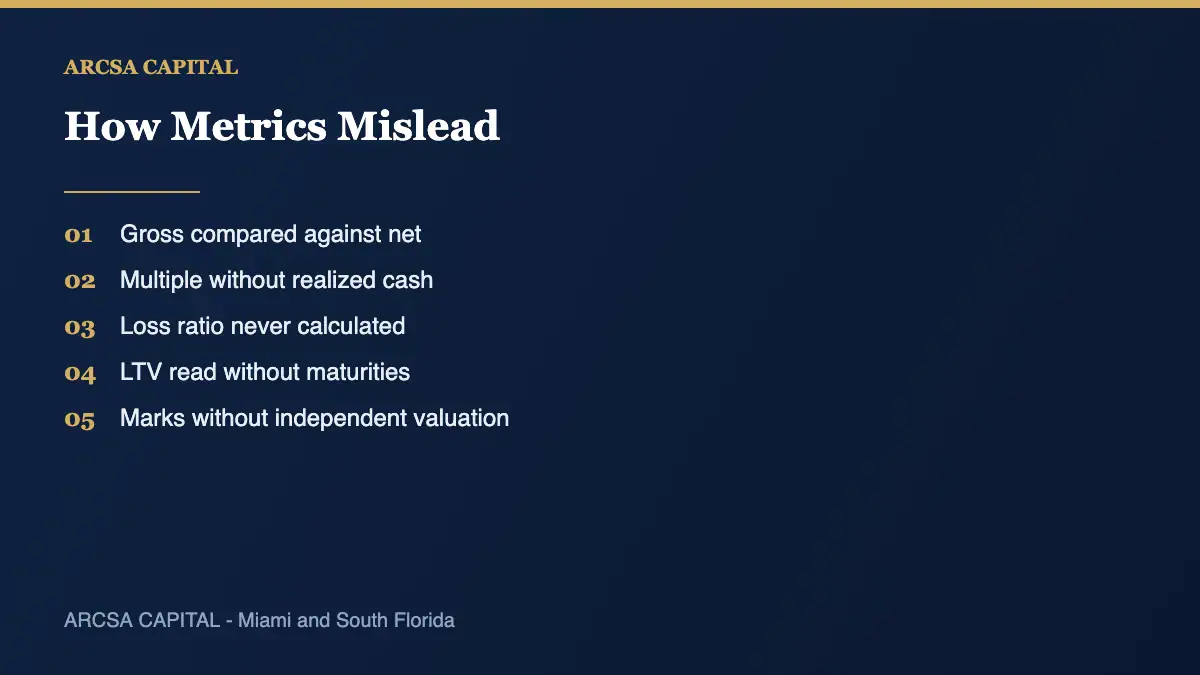
- Comparing a gross internal rate of return from one manager with a net figure from another.
- Accepting a strong multiple without asking how much of it is realized in cash.
- Ignoring the loss ratio because the average outcome looks acceptable.
- Reading loan to value without maturity dates, covenants and recourse provisions.
- Treating diversification as achieved when exposure is concentrated in one submarket and vintage.
- Allowing unrealized marks produced without independent valuation to carry full weight.
- Completing fund due diligence without reconciling a single reported figure against public records.
Each of these is avoidable in an afternoon. The purpose is not to distrust the manager but to ensure the figures mean what the investor assumes they mean.
How to Run Fund Due Diligence in 30 Days
Week 1 – Normalize the numbers
Restate every metric on a consistent basis: net of all fees, by vintage, with realized and unrealized separated. Fund due diligence cannot begin until the figures from different managers describe the same thing, and this step alone frequently changes the ranking.
Week 2 – Test the realized record
Isolate closed transactions and calculate distributions to paid in capital and the loss ratio from them alone. Then verify four of those transactions against county records. What survives this step is the part of the track record that can actually be relied upon.
Week 3 – Examine risk and concentration
Build the exposure map by submarket, asset type, vintage and counterparty, and lay the debt schedule beside it. Look for maturities clustered in a single window, recourse provisions and covenants that could force a sale at an inconvenient moment.
Week 4 – Assess governance and reporting
Confirm administrator, auditor and valuation policy independently. Review two historical investor reports and check whether a weak quarter was reported with the same clarity as a strong one. This is where fund due diligence moves from numbers to behavior.
Frequently Asked Questions About Fund Due Diligence
Which single metric matters most?
Distributions to paid in capital, because it measures cash that actually reached investors and cannot be produced by a valuation assumption. It should still be read alongside the loss ratio and the realized share of the record, since a high figure from one exceptional exit is not a process.
Is a high internal rate of return always positive?
Not necessarily. A short hold can produce an impressive annualized figure on a small absolute gain, and the metric is sensitive to the timing of capital calls. Fund due diligence reads it beside the equity multiple, which is far harder to flatter.
How should unrealized value be treated?
With weight proportional to the independence of the valuation. Independently valued positions audited by an external firm deserve consideration. Manager marks without third party verification should be discounted heavily, particularly in a market where recent comparable sales are scarce.
What is a reasonable loss ratio?
It depends on strategy. A value add residential program with a low loss ratio across a full cycle demonstrates underwriting discipline. What matters more than the level is whether the manager discusses losses openly and can explain what changed in the process afterwards.
How much time should this take?
Four to eight weeks for a first commitment to a new manager. Compressing it usually means skipping verification, which is the part of fund due diligence that changes decisions rather than the part that confirms them.
Key Takeaways on Fund Due Diligence
- Normalize every figure to net, by vintage, realized separated from unrealized.
- Distributions to paid in capital is the metric hardest to flatter.
- The loss ratio reveals underwriting discipline better than the average outcome.
- Read leverage as a schedule of maturities and covenants, not as a single ratio.
- Discount unrealized marks that lack independent valuation.
- Reconcile reported results against public records before relying on them.
- Fund due diligence ends with behavior: how the manager reports a bad quarter.
ARCSA Capital supports institutional fund due diligence with transaction level disclosure, independent administration and asset level reporting across prime residential investments in Miami and selected Florida submarkets. This article is general information and does not constitute legal, tax or investment advice.
Fund due diligence should end with evidence, not impressions
Speak with our team about track record verification, governance and reporting standards.
Request InformationOr model your own scenario in the investment simulator
Or receive the ARCSA Capital investment thesis by email, with the entry, stabilisation and exit assumptions behind the strategy:
